Contact us through DILA Yahoo Group

Issues concerning Philippine language policy
. .
ANNOUNCEMENT
The 80-page DILA booklet may be purchased in quantities of ten booklets at the discounted price of 750.00 pesos. This is now available at Clinica Henson, #066 MacArthur Highway, Angeles City in Pampanga near the city post office. The contact number is (6345) 625-2525, just ask about Josie Henson's FILIPINO IS NOT OUR LANGUAGE if you are going to call.

Less and less of the Tagalogista in Google
The Tagalogista grip is only starting to loosen and we hope to banish it entirely from the Philippines some day. Google has realized the ill effects of Tagalogization and recently stopped aggressively pimping Tagalog translation in Gmail and Youtube.
May 16, 2013 update: The main search page of google.com.ph has reverted to English initialization.
Interview of Tim Harvey by Bobit Avila (September 1, 2014): Part 1 2 3 4 Youtube 1 hr with ads
45 minute audio podcast 
DILA message 25348 to 50 Political rhetoric and policy against languages
Cultural imperialism an enduring threat to linguistic diversity
Message from Archbishop Capalla admonishing celebrants from mixing Tagalog into the Cebuano mass
Self-deception of a deluded nation

In the News Elsewhere
From DILA
 On education
There are to be almost 20 million schoolchildren enrolled in 2002-2003. Under the Basic Education Curriculum of Secretary Roco, their instruction will begin to focus only on the five subjects of Filipino, English, Mathematics, Science and Makabayan.
What is the national language policy of the Republic of the Philippines?
It is the same one that has been destroying our languages since 1935. Diglossia as national policy
Partial list of private companies that promote the Tagalog national language in our provinces
ABS-CBN, Jollibee, Smart Communications, GooglePh, Cebu Pacific, Lhuillier, Inquirer, San Miguel,...
Google no longer defaults to Tagalog as of May 16, 2013
They switched their search language to Tagalog throughout the Philippines in 2004 and expanded this as their language default in all Google assets. They do not do this in countries like Malaysia, India and Uganda. They use English there. See
google 2005 2012 2013 online ad gmail 2012 google chrome blogspot youtube 2012 translate
Changes as of May 10, 2013 default cebuano search May 16, 2013 default fully restored to english ot.he.rs
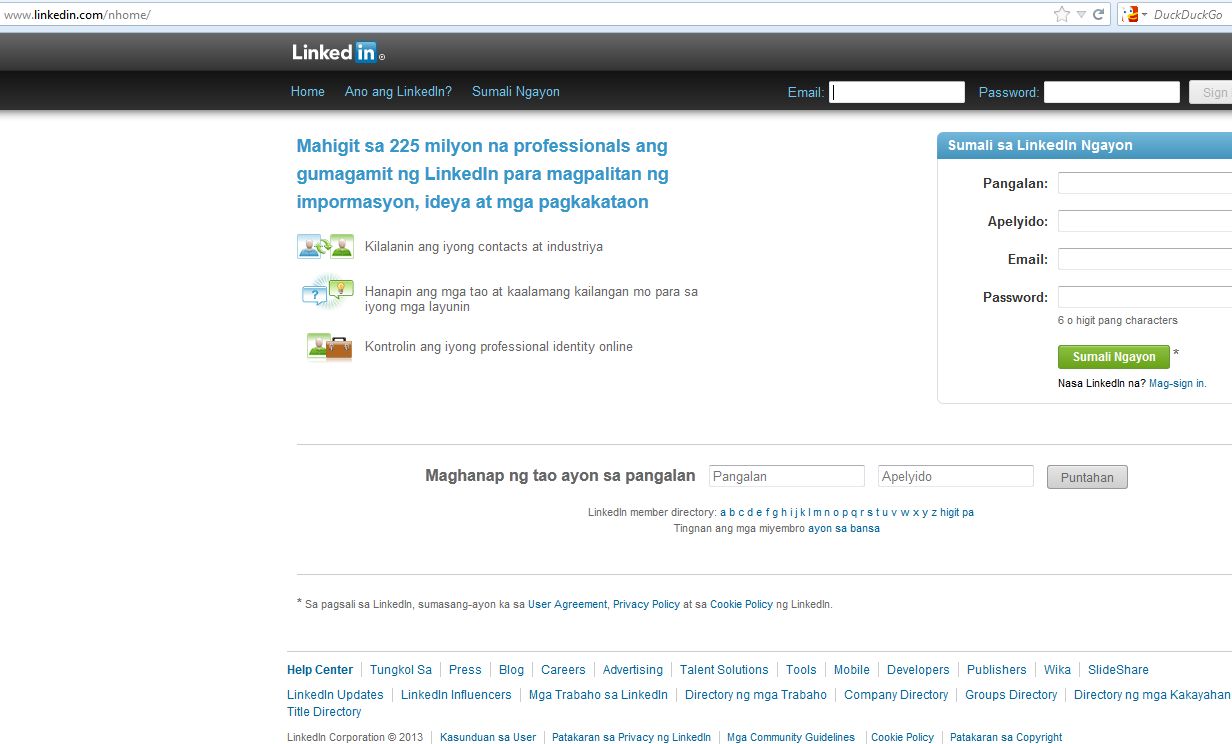
BLATANTLY IN TAGALOG: inquirer 2013 change.org Facebook tagalog is not the default but is prominent ad pay for like facebook log-in of change.org linkedin
NOT IN TAGALOG: yahoo! philippines avaaz.org firefox_first run firefox search
by Vicente Albano Pacis language of ignorance criminal history of filipino sabotaged by recto
Statement from Prof. Guillermo Gomez-Rivera back in 1981 against the national language
Filipinos do not need Pilipino in their school curricula except in the primary grades in the Tagalog speaking areas. The language problem made more damning with a new colonialism: the imposition of Pilipino in our school system.
Manny delivered his message with aplomb and dignity, but the segment was structured in such a way that anything anyone had to say against the so-called "National Language" was bound to sound like a mere tantrum.
Link to Merlie's review
By Josefina Dizon Henson.
The short story was crafted in 2004 for children in Dumaguete City aged ten to twelve. Translation to English was meant to be literal in order to allow learners to assess their own comprehension.
What is "Filipino?" There is much difference of opinion on this matter. According to one school of thought, Filipino is not only different from Tagalog, but that it (Filipino) still does not exist, but on the contrary, it still has to be developed.
 Ethnic cleansing in the Philippines
The United Nations Convention on Genocide drafted in December 1948 mainly defines the physical means by which governments or rogue militia weed out ethnic or cultural communities. With bullets or bladed weapons, separation of younglings from their elders, we've heard it all before from the news and read it in the history books. Original in Kapampangan and Cebuano
 List of Philippine languages
Republic of the Philippines. 86,241,697. National or official languages: Filipino, English. Literacy rate: 88% to 89%. Also includes Basque, French (698), Hindi (2,415), Indonesian (2,580), Japanese (2,899), Korean, Sindhi (20,000), Standard German (961), Vietnamese, Arabic. Information mainly from L. A. Reid 1971; SIL 1954–2003. Blind population: 1,144,500. Deaf population: 100,000 to 4,232,519 (1998). Deaf institutions: 17. The number of languages listed for Philippines is 175. Of those, 171 are living languages and 4 are extinct.
DILA vocabulary sampler spreadsheet format wordlist pdf format wordlist Official Cebuano Orthography
The central question of this study is whether or not Waray schoolchildren are shifting from their Waray mother language to Tagalog and English.
Language is a vessel that is both necessary and consequent to the flourishing of culture and identity, which in turn is essential to nation building.
There was no venue to publish except radio. The pressure was to write in English and Filipino, but the competition for literary space was fierce.
By a sly, clever wording in the Philippine constitution that "Filipino is the national language," the Tagalista framers avoided an unyielding opposition to Tagalog while anointing it a national sounding name, "Filipino".
Publications
 We organized DILA in 2001 to defend the language rights of all our ethno-linguistic groups. It is said that of the 7,000 languages spoken around the world today, more than half are expected to be lost in this century alone. They might disappear from causes like wars and disasters but what concerns us is when the reason is that another tongue is forcibly imposed by government. When that happens, disuse of the native tongue follows and the ultimate result is extinction. Since the introduction of a national language in our country in 1935, our 169 non-national languages have declined and deteriorated. All these and more are lucidly presented in the following posts and articles lifted from our group page on the internet (http://groups.yahoo.com/group/dila). A note from our founder comes after this introduction.
DILA is committed to legal and peaceful means in achieving our aims, and welcome those who share our noble cause to protect our peoples and languages from extinction. May the Lord bless His languages. (From the FOREWORD of the book, Josefina D. Henson, DILA Phils. Foundation Inc. President)

A few samples taken from the discontinued website A Country of Our Own. David Martinez on language policy Example of bad lawmaking
Recommended
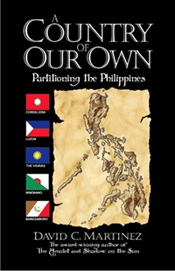
"The best writing on the Philippines I've read in a very long time."—Dr. Michael Ashkenazi, Regents College, London
"Meticulously researched, coherently crafted, passsionately argued."—Carmen Miraflor, Stanford University, California
"Immensely stimulating."—Bro. Andrew Gonzalez, FSC, former Sec. of Education, RP
"Like Alexandr Solshenitsyn, David C. Martinez, writing with the grace of a poet, the acumen of a scholar, and the heart of a patriot, offers the reader two rewards—the unembroidered truth and the priceless gift of hope."—Joseph E. Fallon, author, "Deconstructing America"
"Certain to change crippling misconceptions of 'nation' and 'identity.' Destined to radically, justly, and permanently alter the political landscape of the Philippines."—Nilo Sarmiento, formerly of the Society of Jesus
"Courageously irreverent, scrupulously annotated, and richly rewarding. A must-read for all who wish to comprehend the 'Philippine phenomenon'."—Tim Harvey, Co-Founder, DILA [Defenders of the Indigenous Languages of the Archipelago]
"The Religion of Blame” chapter was well received by Postscript readers. They are encouraged to read the entire book of Martinez"—Federico Pascual, Philippine Star columnist
Non-Tagalog Literature

Non-Tagalog MUSIC CORNER

(right-click picture for option to enlarge and view titles)
Let us support non-Tagalog artists and writers by purchasing legitimate copies of their work.